- Project Case Study
3D Geophysics
in Geneva
Improving the identification and characterisation of Quaternary aquifers using non-invasive 3D Electrical Resistivity Tomography and Induced Polarisation.
Advanced Subsurface Exploration
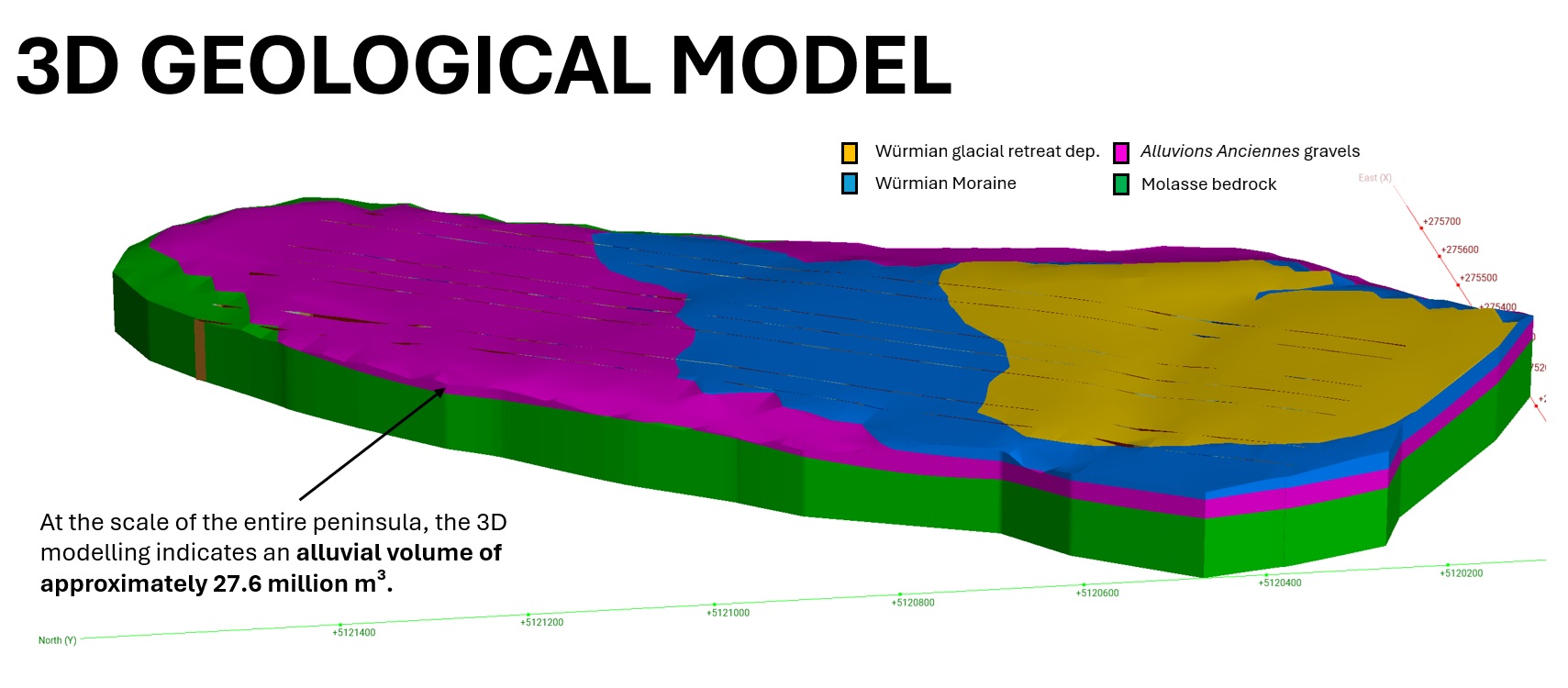
DROPSTONE consultancy proposed to the Services Industriels de Genève an exploratory application of the 3D ERT-IP geophysical method (Electrical Resistivity Tomography and Induced Polarization) to improve the identification and characterization of Quaternary aquifers.
Originally developed and widely used in the mining industry to assess the geometry and quality of exploitable ore bodies, this technology enables detailed imaging of the subsurface in a fully non-invasive manner, without the need for additional drilling or excavation.
The Loëx peninsula, located in the canton of Geneva, was selected as the study site. This area, predominantly agricultural and only lightly urbanized, offers particularly favorable conditions, including proximity to the Rhône River, the availability of several recent boreholes, and a well-documented geological setting. These factors made it possible to test the method on a shallow, well-characterized aquifer, while avoiding significant urban constraints.
The methodology has given convincing results, demonstrating its relevance and effectiveness for subsurface resource management. Applications include drinking water supply, low-enthalpy geothermal energy, as well as industrial gravel extraction.
This study illustrates the strong potential of geophysical methods originally developed for mining when applied to contemporary hydrogeological and land-use challenges.
Scientific Reference Document
Technical Leaflet: 3D Exploration Geophysics
If you wish to know more about the usefulness of 3D exploration geophysics for the identification of gravel bodies, follow this link to review the comprehensive overview.
Project Specifications
Exploration Geophysics
Client
Services Industriels de Genève (SIG)
METHODOLOGY
3D ERT-IP (Electrical Resistivity Tomography & Induced Polarization)
Study Site
Loëx Peninsula, Canton of Geneva, Switzerland
Target systems
Quaternary aquifers / Gravel bodies identification
Non-Invasive Solution
“The application of geophysical methods originally developed for mining addresses contemporary hydrogeological and land-use challenges without additional excavation or drilling.”